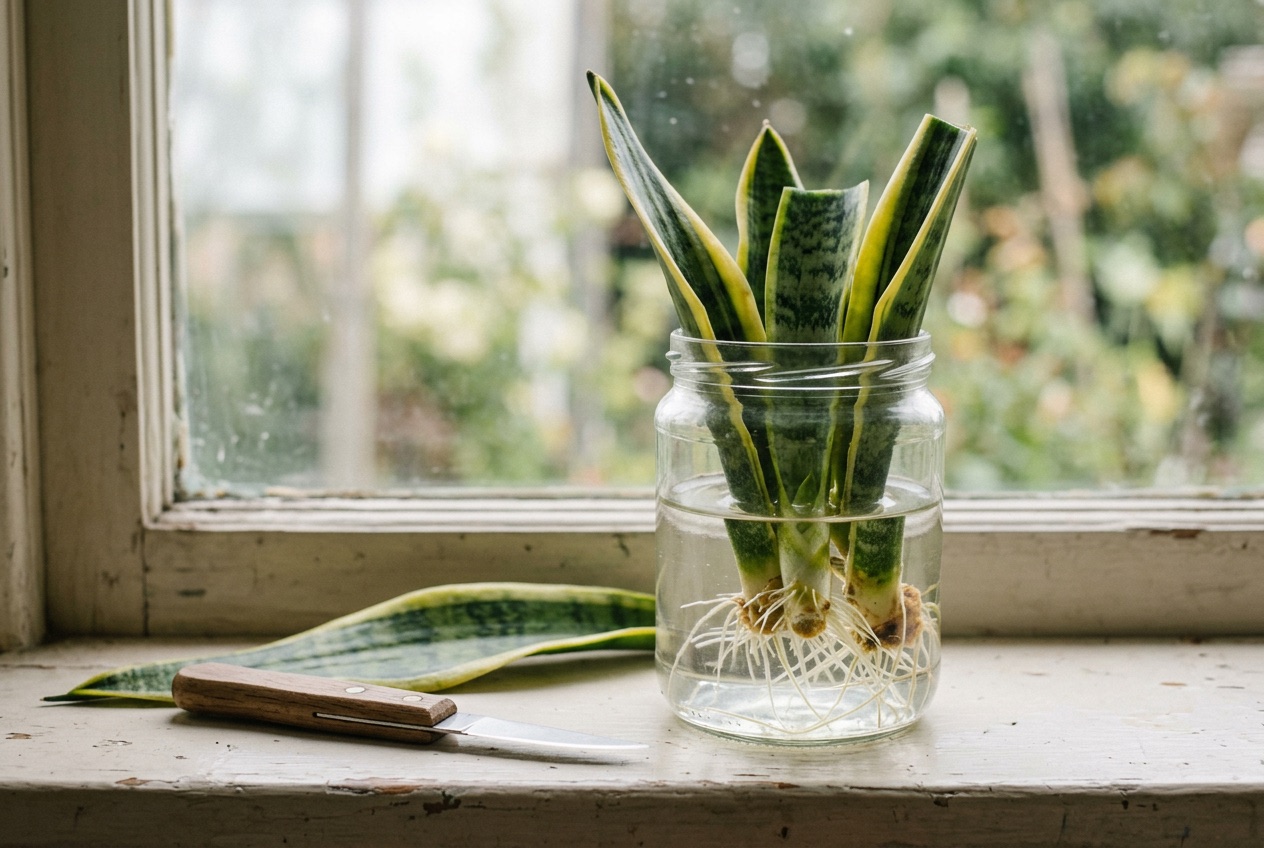
There are three ways to turn one snake plant into several. Two of them are commonly taught and one of them is usually the right answer.
Before you pick: if your plant has yellow edges, read the section on variegation first. It changes which method you should use, and it is the single most common way people are disappointed by a propagation that otherwise worked perfectly.
Method 1 — Division
Best for: almost everyone. Fastest results, keeps variegation, produces a real plant immediately.
Snake plants grow from rhizomes — thick horizontal underground stems that send up new shoots, called pups. A mature plant in a full pot is usually several plants already, joined underground.
- Slide the whole plant out of its pot and knock the soil off the roots so you can see what you're doing.
- Look for natural divisions — clumps of leaves with their own roots attached.
- Separate them by hand where you can. Where the rhizome is too thick, cut it with a clean knife, making sure each piece has both leaves and roots.
- Pot each division into gritty mix, in a pot only slightly wider than its roots.
- Wait a week before watering. The cut surfaces need to callus over, and watering into fresh wounds is how you get rot.
You have finished plants the same afternoon. No waiting.
Method 2 — Leaf cuttings in water
Best for: making many plants from one leaf, and for watching roots form, which is genuinely satisfying.
- Cut a healthy leaf at the base.
- Cut it crossways into sections about 5–8 cm (2–3 in) long. Keep track of which end was down — a section planted upside down will never root. Many people nick a small notch in the bottom edge of each piece.
- Let the pieces dry for a day or two until the cut ends feel dry to the touch.
- Stand them bottom-end down in a jar with two or three centimetres of water.
- Change the water weekly.
Roots appear in three to five weeks. Pups — the actual new plants — take two to four months after that. Pot each section once its pup has a few centimetres of leaf.
Method 3 — Leaf cuttings in soil
Identical to the water method, but the dried sections go straight into damp gritty mix, an inch deep. Slightly lower failure rate than water because there is no transition shock when potting up, and slightly less interesting because you cannot see anything happening.
Rooting hormone is optional and makes little measurable difference on this plant.
The variegation problem
This is the part that gets left out.
If your snake plant has yellow edges — the Laurentii variety, and it is the most commonly sold one — that yellow margin is a chimera. It exists only in one cell layer of the original plant's growing tissue, and it is not carried in the tissue that regenerates from a leaf cutting.
A leaf cutting from a Laurentii will root, grow, and come up plain green. The plant will be perfectly healthy and it will not look like its parent. This is not a mistake you made; it is how the plant works.
If you want to keep the yellow edges, you must divide. Division carries the existing growing tissue intact, so the pups keep the variegation.
Silver and grey-green varieties like Moonshine behave the same way — divide, don't cut. Plain green varieties can be propagated any way you like.
How long everything takes
| Method | First roots | A real plant |
|---|---|---|
| Division | already rooted | immediately |
| Leaf cutting, water | 3–5 weeks | 4–6 months |
| Leaf cutting, soil | 4–6 weeks | 4–6 months |
Propagate in spring or early summer if you can. A cutting taken in November will sit and do nothing until March — not dead, just waiting.
Why cuttings fail
- Planted upside down. They will sit in water for months and never root. Mark the bottom.
- No callus. Fresh wet cuts rot. Let them dry a day or two first.
- Watered too soon after division. Same reason. Wait a week.
- Winter. Not a failure, just dormancy. Leave them.
- Impatience. Four months is normal. A rooted cutting with no pup yet has not failed.
For most people, most of the time: take the plant out of its pot, pull it into three, pot them up, don't water for a week. You'll have three snake plants by dinner, and if it was a Laurentii, all three will still have yellow edges.