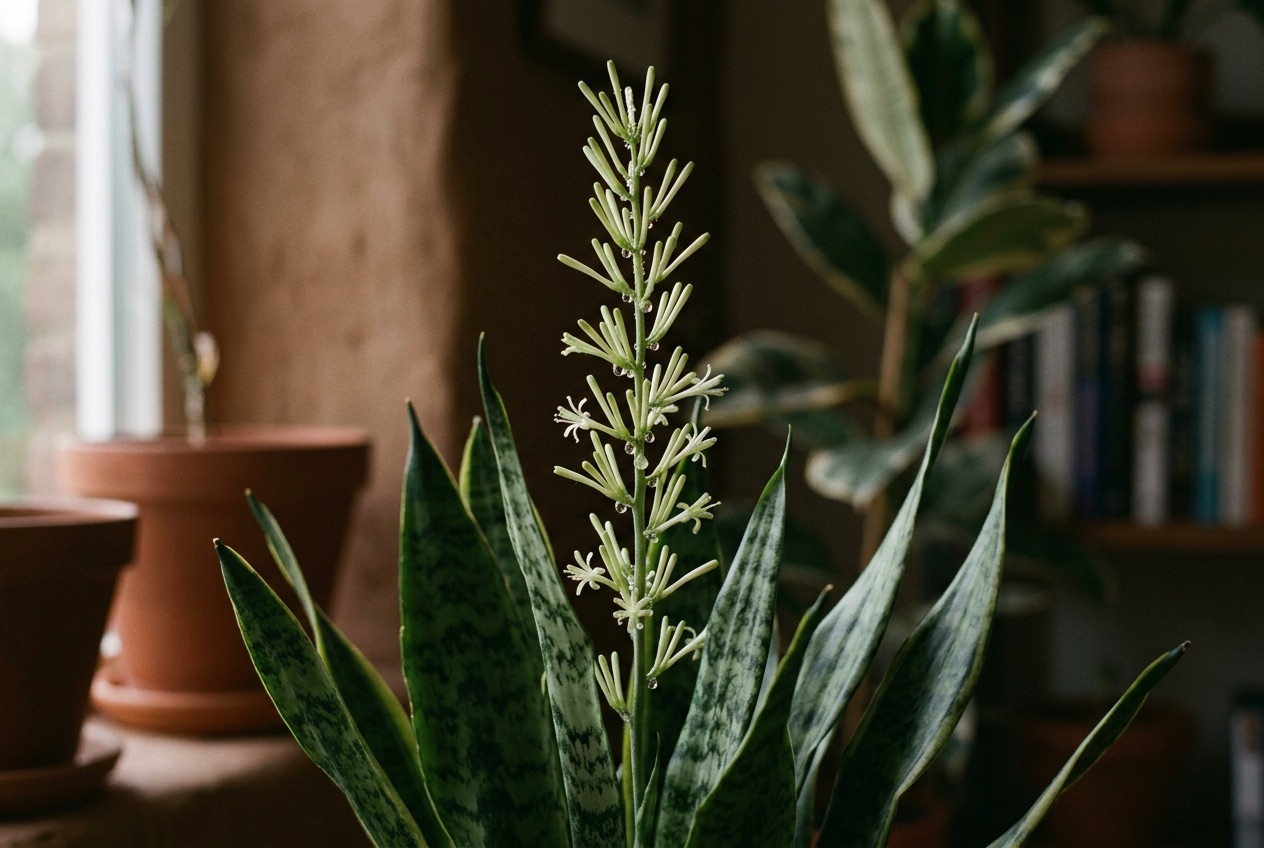
Most people who own a snake plant will never see it flower. Those who do usually assume something has gone wrong, because the flower spike looks nothing like the plant it came from — a thin pale stem, sometimes a metre tall, lined with narrow greenish-white tubular flowers that open at night and drip a clear, sticky nectar.
Nothing has gone wrong. It is a good sign, in an unexpected way.
What triggers it
Snake plants flower when they are established, mature, and mildly stressed. In practice that means:
- Rootbound. A plant that has filled its pot completely and is pressing against the sides is the single most common condition preceding a bloom.
- Several years old. Young plants do not flower. Five years is a reasonable minimum.
- Consistent bright light. Plants in dim corners rarely bloom at all.
- A dry spell followed by water, particularly moving from winter dryness into spring.
The underlying logic is old: a plant that senses it cannot expand any further underground puts its remaining resources into reproduction instead. Comfort produces leaves. Constraint produces flowers.
This is why a snake plant repotted into a generous pot every year may never flower, and one that has sat in the same crowded terracotta since 2019 suddenly throws a spike.
What it looks and smells like
The spike emerges from the base, between the leaves, and grows quickly — often several centimetres a day. The buds open in sequence from the bottom upward over one to two weeks.
The scent is strong, sweet and vanilla-like, and it arrives in the evening. The plant is pollinated by moths in its native range, so the flowers open after dark and the fragrance is timed to match. During the day you may smell nothing at all.
The nectar is real nectar. It beads along the stem and it is genuinely sticky — enough to mark a windowsill or a wooden floor beneath it. Put something under the plant if the surface matters to you.
What to do about it
Very little.
- Leave the spike while it blooms. It costs the plant something, but not enough to harm an established specimen.
- Wipe the nectar off nearby surfaces before it dries, or slip a saucer underneath.
- Cut the spike at the base once the flowers brown, with clean scissors. It will not bloom again from the same stem, and leaving a dead spike serves no purpose.
- Do not repot in response. The crowding is what produced the flower. Repotting now removes the condition and stresses a plant that is already spending energy.
- Do not increase feeding. It will not extend the bloom.
Expect no seeds. Indoor snake plants are almost never pollinated, and the flowers simply fade.
Will it flower again?
Possibly, and unpredictably. Some plants bloom in consecutive years once they reach the right size and stay crowded. Others flower once in a decade. There is no reliable way to force it, and the advice you will occasionally see — deliberately underwatering to induce blooming — risks the plant for a result you cannot control.
The honest position is that a snake plant flower is a thing that happens to you, not a thing you achieve. If yours has bloomed, it means you have kept a plant alive and undisturbed long enough for it to run out of room.
That is a reasonable definition of good care.