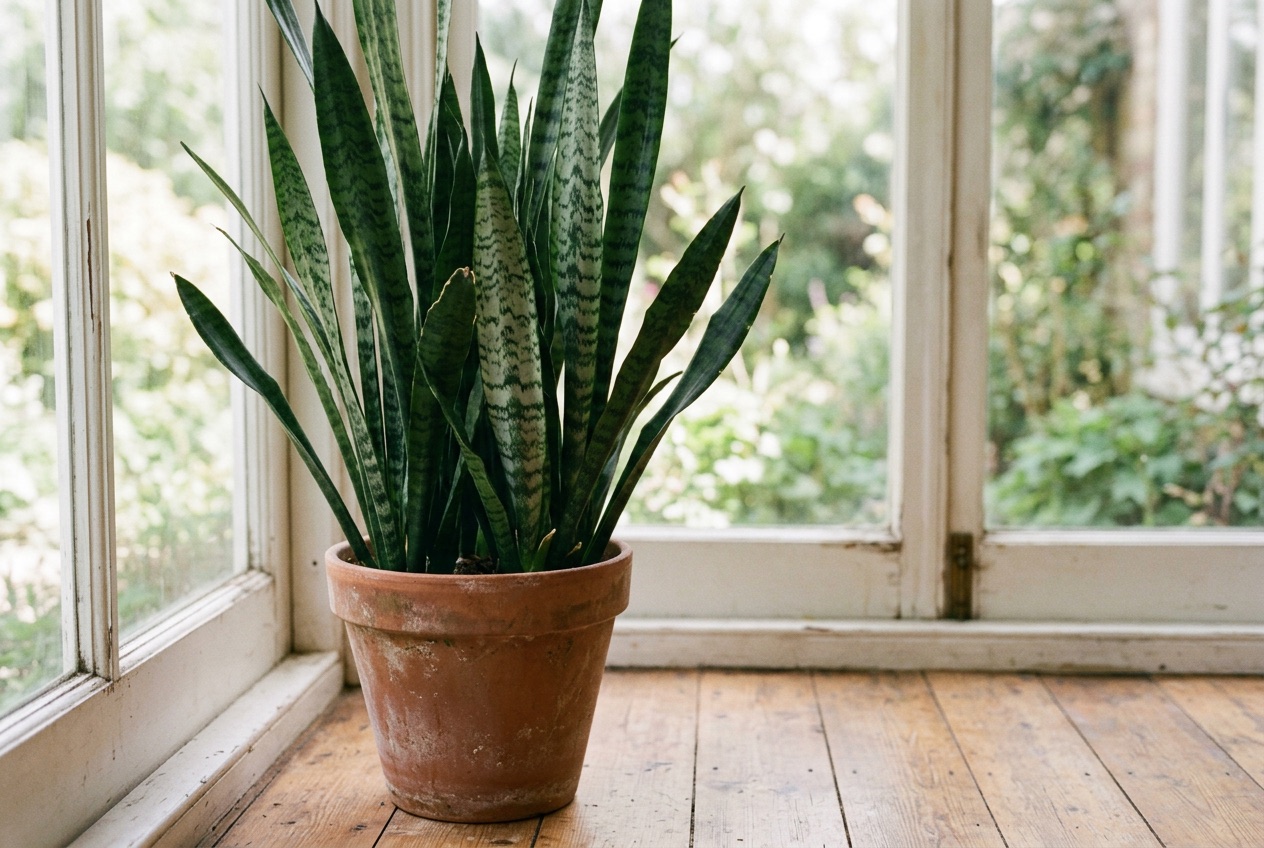
The short answer: water it every two to six weeks, give it any light you have, use gritty soil, and otherwise ignore it. If you do only that, your snake plant will almost certainly outlive the sofa.
The longer answer is worth reading, because the way people kill this plant is so consistent that it is almost a single mistake repeated in different weather.
Specimen at a glance
- Accepted name
- Dracaena trifasciata (formerly Sansevieria trifasciata)
- Family
- Asparagaceae
- Native range
- Tropical West Africa
- Water
- Every 2–3 weeks in summer; 4–6 weeks in winter. Check first, always.
- Light
- Tolerates low; grows in bright indirect; scorches in hard midday sun
- Soil
- Cactus or succulent mix, or compost cut one-third with grit
- Temperature
- 15–27°C (60–80°F). Damage below 10°C (50°F)
- Humidity
- Irrelevant. Do not mist.
- Toxicity
- Toxic to cats and dogs — saponins; mild but real
The one mistake
Snake plants store water in their leaves. They evolved in the seasonally dry scrub of West Africa, where rain arrives in bursts and then does not return for months. The whole plant is built around surviving that gap — thick waxy leaves, a shallow spreading root system, and a metabolism that can idle almost indefinitely.
What that means in a living room is simple: the plant is far better adapted to drought than to your attention. Overwatering causes root rot, root rot is usually fatal, and by the time the leaves go soft at the base the roots have often been gone for weeks.
If you are unsure whether to water it, don't. That single rule prevents most snake plant deaths.
Water
Put a finger into the soil up to the second knuckle. If you feel any moisture at all, wait. If it is dry that far down, water thoroughly — until it runs from the drainage hole — then empty the saucer and leave it completely alone until it is dry again.
In practice that tends to mean:
- Spring and summer: every two to three weeks
- Autumn and winter: every four to six weeks, sometimes longer
Those are not schedules. They are the intervals you should expect to arrive at by checking. A plant in a small terracotta pot on a sunny sill dries out several times faster than the same plant in a large plastic pot in a dim hallway, and a schedule cannot know the difference.
Never leave it standing in water. No saucer full of runoff, no decorative pot without drainage, no self-watering reservoir. If your outer pot has no hole, keep the plant in a plastic nursery pot inside it and lift it out to water.
Light
Snake plants are sold as low-light plants, and that is true in the sense that they will survive a dim corner for years. It is not true in the sense that they will do anything interesting there.
- Bright indirect light — a few feet back from an east or west window — is where they actually grow. Expect new leaves each season, strong colour, and tight upright form.
- Low light is tolerated. Growth slows to near nothing, variegation fades, and new leaves come in narrower and floppier.
- Direct midday sun through glass can scorch them, particularly if the plant has been in shade and is moved suddenly. Move it in stages over a couple of weeks.
A useful rule: the less light you give it, the less water it needs. Light drives growth, growth uses water, and a plant in a dark corner that is watered on a bright-window schedule is a plant with rotting roots.
Soil and pots
Use a cactus or succulent mix. If you only have standard potting compost, cut it by about a third with perlite, pumice or coarse grit. What you are aiming for is a mix that water runs through rather than sits in.
Terracotta is genuinely better than plastic here, because it breathes and dries the rootball from the sides as well as the top. It is one of the few cases where the traditional pot is not just aesthetics.
Snake plants like being crowded. A rootbound plant is a happy plant, and repotting more than every two or three years is usually counterproductive — a large volume of fresh damp compost around a small root system is exactly the condition root rot likes. When you do repot, go up one pot size, not three.
Feeding
Almost optional. A balanced houseplant feed at half strength, two or three times across spring and summer, is plenty. Nothing at all in autumn and winter. A snake plant that is fed heavily grows soft, and soft growth on this plant means leaves that flop instead of standing.
Temperature and humidity
Normal room temperature suits it. It is comfortable roughly between 15°C and 27°C (60–80°F), and it does not want anything below about 10°C (50°F) — cold damage shows up as translucent, mushy patches.
Ignore humidity entirely. This is one of the very few popular houseplants for which misting, pebble trays and humidifiers do nothing useful.
What normal looks like
- Slow growth. A few new leaves a year is a healthy pace. This is not a plant that visibly changes week to week.
- Old outer leaves eventually going brown at the tip and dying back. Normal, particularly on the oldest leaves. Cut them at the base if they bother you.
- Nothing happening all winter. Also normal. Do not respond to it by watering.
When to actually worry
| Symptom | Usually means | What to do |
|---|---|---|
| Soft, mushy base, sometimes a smell | Root rot from overwatering | Unpot now. Cut away every brown or slimy root, repot into dry gritty mix, no water for two weeks |
| Leaves wrinkling, curling inward | Genuine thirst — rarer than people assume | Water thoroughly, then resume checking |
| Wide, floppy new growth | Not enough light | Move to brighter indirect light; expect the old leaves to stay as they are |
| Brown crispy tips on old leaves | Age, or tap-water minerals | Nothing, or switch to filtered water. Trim if it bothers you |
| Translucent, water-soaked patches | Cold damage | Move away from the draught or window; damaged tissue will not recover |
| Pale, washed-out banding | Too much direct sun | Move back from the glass over two weeks, not all at once |
The plant's name
You will see this plant sold as Sansevieria trifasciata and as Dracaena trifasciata. Both refer to the same plant. Genetic work led botanists to fold Sansevieria into Dracaena in 2017, so Dracaena trifasciata is the current accepted name — but the nursery trade has been slow to change, and "sansevieria" remains the word most growers use. Neither is wrong in conversation.
If you take one thing from this: the snake plant does not need you very much. Most of the care is restraint, and the gardener's instinct to intervene is the main thing standing between you and a plant that lasts twenty years.